
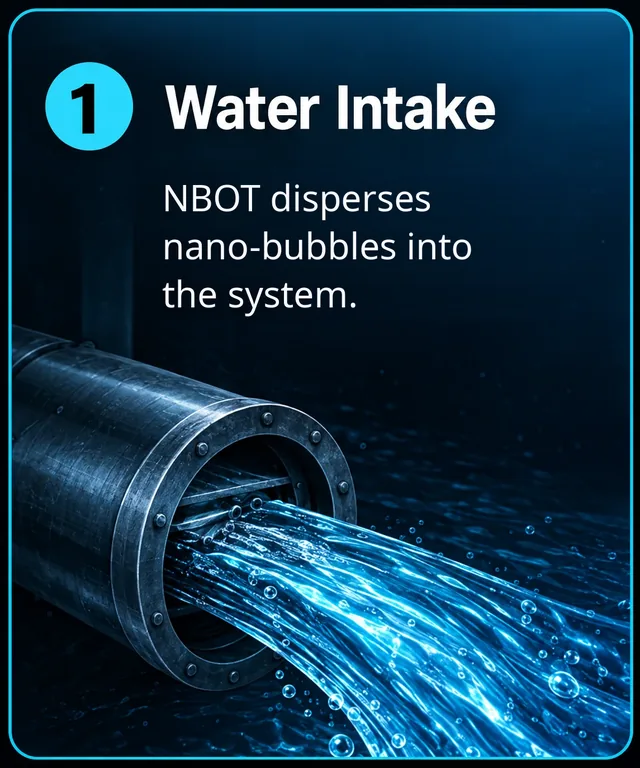
Water Intake
Contaminated water enters the NBOT system, where nano-bubbles are dispersed throughout the flow.
NBOT harnesses nano-bubble physics to generate hydroxyl radicals — among the most powerful oxidizers in water treatment.
A short overview of how NBOT nano-bubble ozone technology works.
A paradigm shift in advanced oxidation powered by patented nano-bubble technology.
Contaminated water enters the NBOT system, where nano-bubbles are dispersed throughout the flow.
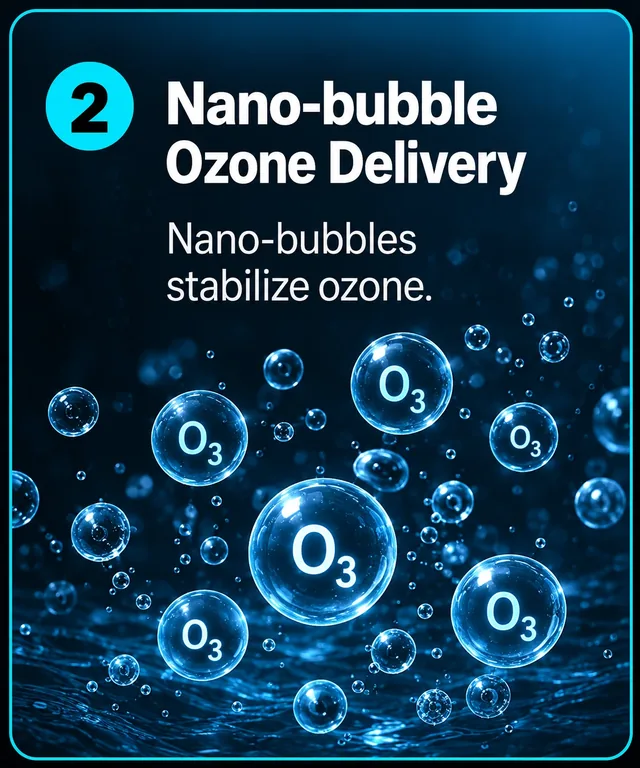
NBOT infuses ozone into the water as ultra-small, stable nano-bubbles. Each carries an O₃ payload and stays suspended far longer than conventional bubbles, extending ozone contact time.
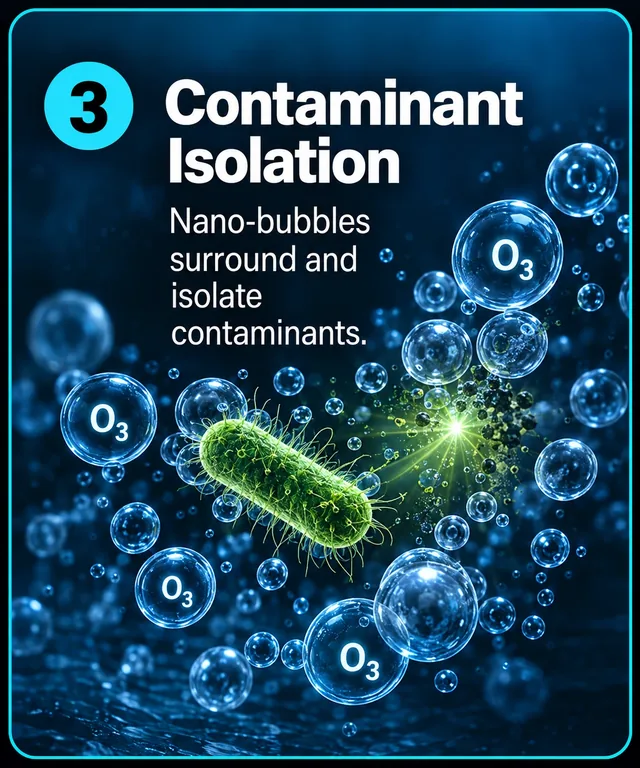
Negatively charged nano-bubbles are electrostatically attracted to contaminants such as PFAS, microplastics, bacteria, and organic compounds, surrounding and isolating them.
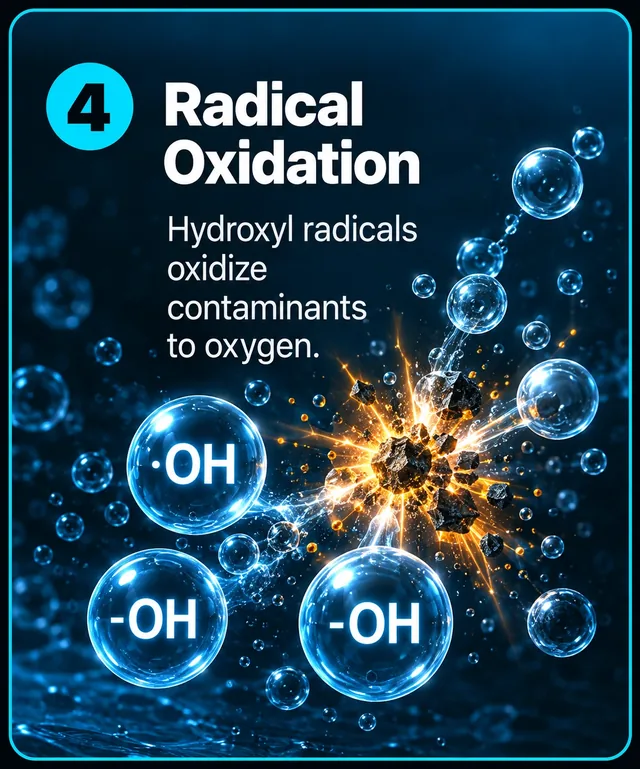
As the ozone nano-bubbles decompose, they trigger O₃ + H₂O → •OH + O₂, releasing powerful hydroxyl radicals that react immediately with contaminants.
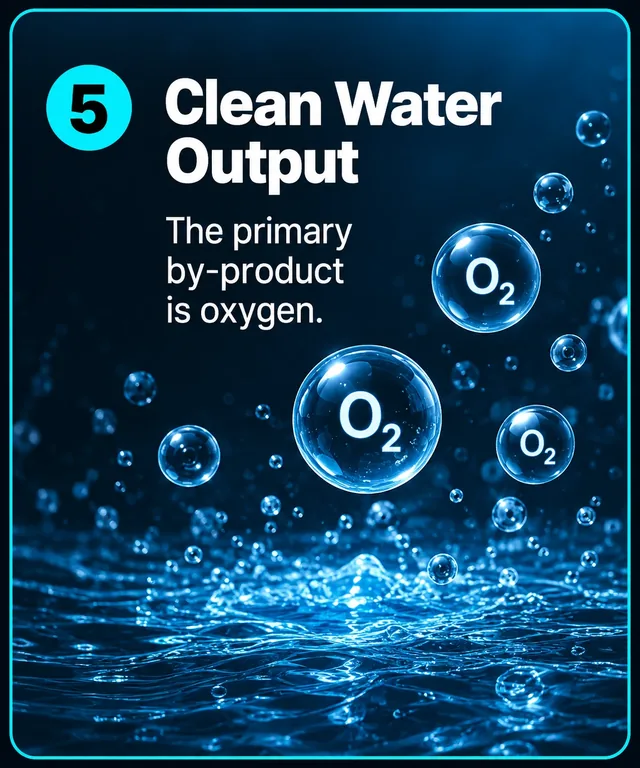
The contaminants are destroyed and treated water leaves the system. The only product residual is dissolved oxygen, with no harmful disinfection byproducts.
Hydroxyl radicals are one of the strongest oxidants known to science—over 100,000 times stronger than chlorine, and 2,000× stronger than ozone alone.
Second only to fluorine in oxidative power, hydroxyl radicals exist for fractions of a second, reacting immediately with contaminants.
NBOT generates hydroxyl radicals precisely at the point of contamination—not in bulk solution. This ensures no oxidation potential is wasted.
Up to 10× longer nano-bubble contact time compared to conventional bubbles, extending ozone contact time.
Elimination of organic contaminants, plus reduction of PFAS, heavy metals and nutrients.
Hydroxyl radicals destroy the nucleus, DNA and protein layer of microorganisms, and this killing mechanism prevents bacterial resistance buildup.
Destroys the functional groups within organic molecules—carboxylic acids, amines, sulfides, phosphates—completely dismantling contaminant structures.
The only residual byproduct is dissolved oxygen—no chemical footprint and no secondary chemical waste streams.
Treatment benefits may continue for approximately 20 days post-application (at 45°C), depending on specific deployment conditions and water chemistry.
One partner. One platform. Complete lifecycle management, with no gaps and no handoffs.
Explore applications, view specifications, or request a comprehensive assessment.